
Parker Bauer · 23 October 2026
Cross-Border Student Projects Fueling New Standards for Remote Science Training Access
Universities across Europe, North America, and Asia have expanded joint student initiatives that connect remote participants through shared digital platforms, and these efforts continue to shape consistent protocols for science training access. In October 2026 several multi-country consortia released updated guidelines that align virtual experiment modules with accreditation requirements in participating regions, which allows students in different time zones to complete equivalent coursework without physical relocation.
Data from the European Higher Education Area shows that cross-border teams completed over 1,200 collaborative biology and chemistry modules during the 2025 academic year, while similar figures from the National Science Foundation in the United States record 870 joint projects involving undergraduate cohorts from at least three nations each. These numbers reflect coordinated scheduling systems that synchronize lab simulations across continents, and they also highlight shared assessment rubrics that faculty from multiple institutions review together.
Building Shared Infrastructure for Virtual Experiments
Student groups in these projects typically select open-source simulation tools that run on standard browsers, then they integrate custom data-logging scripts developed by partner teams. One consortium linking institutions in Poland, Canada, and Australia standardized file formats for experimental results last year, which reduced compatibility issues that previously delayed joint analysis sessions. Researchers at participating universities note that this format now appears in course materials at more than 40 additional campuses, and it supports automated grading pipelines used by both European and North American accreditors.
Faculty coordinators report that students gain experience with remote instrumentation controls through scheduled access windows, whereas earlier independent platforms often limited users to single-institution logins. The new arrangements distribute server loads across partner data centers, and they maintain audit logs that satisfy data-protection rules in each jurisdiction.
Standards Emerging from Joint Course Design
Working groups composed of students and instructors draft learning outcomes that map directly onto national qualification frameworks, and they test these outcomes through pilot cohorts before wider release. In 2026 several groups published rubrics that evaluate both technical accuracy and collaborative problem-solving, which address skills required by employers who recruit across borders. Observers note that these rubrics now influence internal review processes at universities that previously maintained separate evaluation criteria for online versus in-person labs.
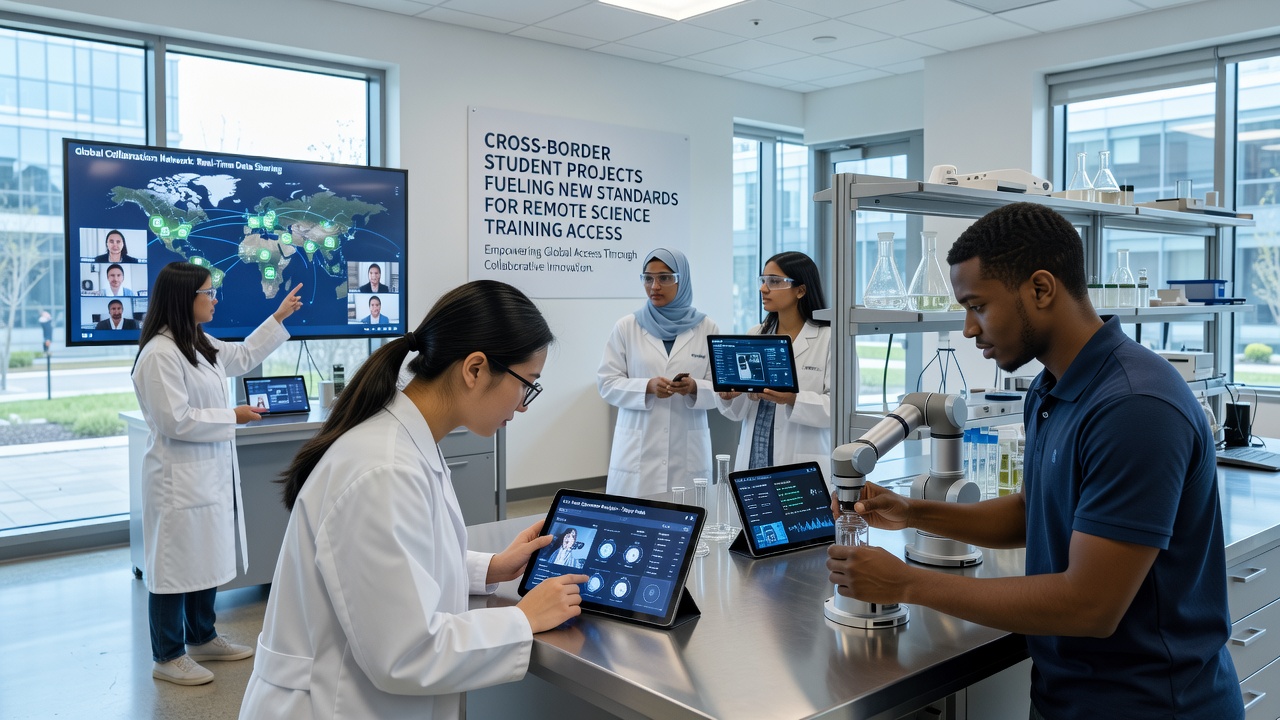
Surveys conducted by the Association of Commonwealth Universities indicate that 68 percent of participating students accessed equipment or datasets unavailable at their home institutions, and completion rates for the joint modules reached 92 percent across tracked programs. These results appear in reports that compare outcomes before and after the introduction of shared calendars and multilingual support interfaces.
Regional Adaptations and Access Expansion
Institutions in Eastern Europe and Southeast Asia adapted the core simulation packages to local network conditions by compressing data streams and adding offline review options, while teams in Latin America incorporated Spanish and Portuguese interfaces alongside English versions. Such modifications preserve core learning objectives yet accommodate bandwidth variations, and they receive feedback through joint evaluation meetings held every quarter.
Government education ministries in several countries have begun referencing these student-developed standards when updating digital learning policies, which creates pathways for credit recognition between systems that previously required separate validation. Records from the Organisation for Economic Co-operation and Development show rising enrollment in remote science programs among students from lower-resource regions, and the increase correlates with the rollout of cross-border project templates.
Conclusion
Cross-border student projects continue to generate practical templates that other institutions can adopt, and the resulting standards emphasize interoperability, equitable access, and measurable learning outcomes. As more universities integrate these models into their curricula, remote science training becomes available to wider audiences while maintaining consistency across national boundaries.